
Tunbridge, Tasmania
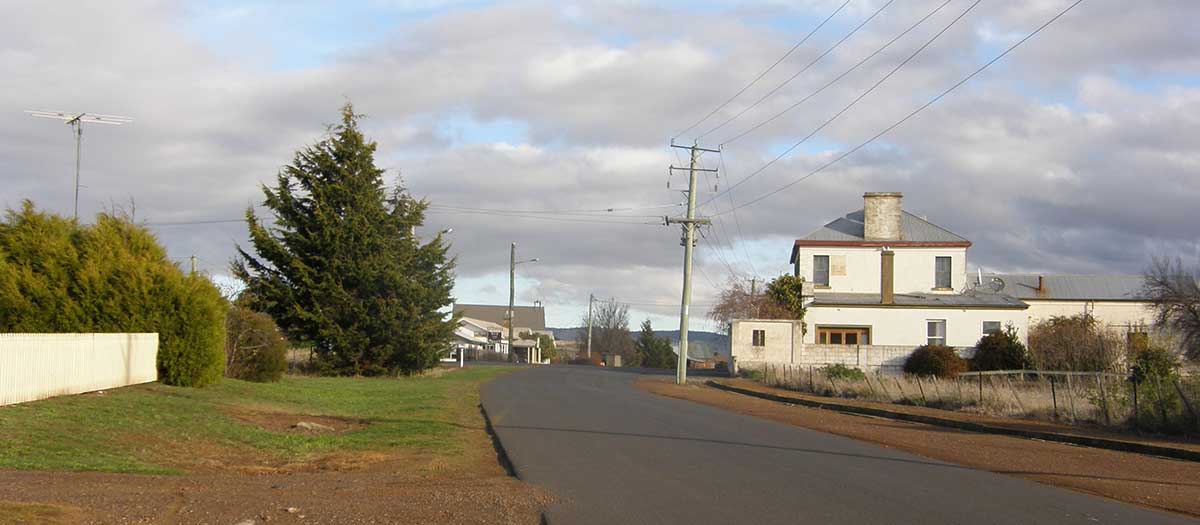
Tunbridge was originally a coaching stop on the Hobart to Launceston road, now known as the Midlands Highway. It was named after one of its three original coaching inns, the Tunbridge Wells, which in turn was named after Tunbridge Wells in Kent, England. At the 2006 census, Tunbridge had a population of 192.
The area grew rapidly in the 1810s as convicts worked on the road from the north to the south of the island. Stage coaches began stopping at Tunbridge soon after the Hobart to Launceston mail service was inaugurated on 23rd October 1816. In its coaching heyday Tunbridge had three coaching inns, the Tunbridge Wells Inn, the Victoria Inn and the York Inn. Each inn was associated with a different coaching company. Tunbridge Wells Inn serviced J. E. Cox Coaches, the Victoria Inn serviced Samuel Page Coaches and the York Inn serviced Alfred Burbury Coaches. Tunbridge Post Office opened on 17 March 1856.

Originally known as Tunbridge Wells (after the famous English spa town), Tunbridge is located 92 km from Launceston and 107 km from Hobart. It has been by-passed by the main Midland Highway and consequently has a quiet charm well removed from the urgency of the highway. The town came into existence in 1809 and quickly developed into an important coaching stop between Hobart and Launceston. The area grew rapidly in the 1810s as convicts worked on the road from the north to the south of the island. In recent times the town has been by-passed which has meant that it has been able to maintain much of its historic charm.
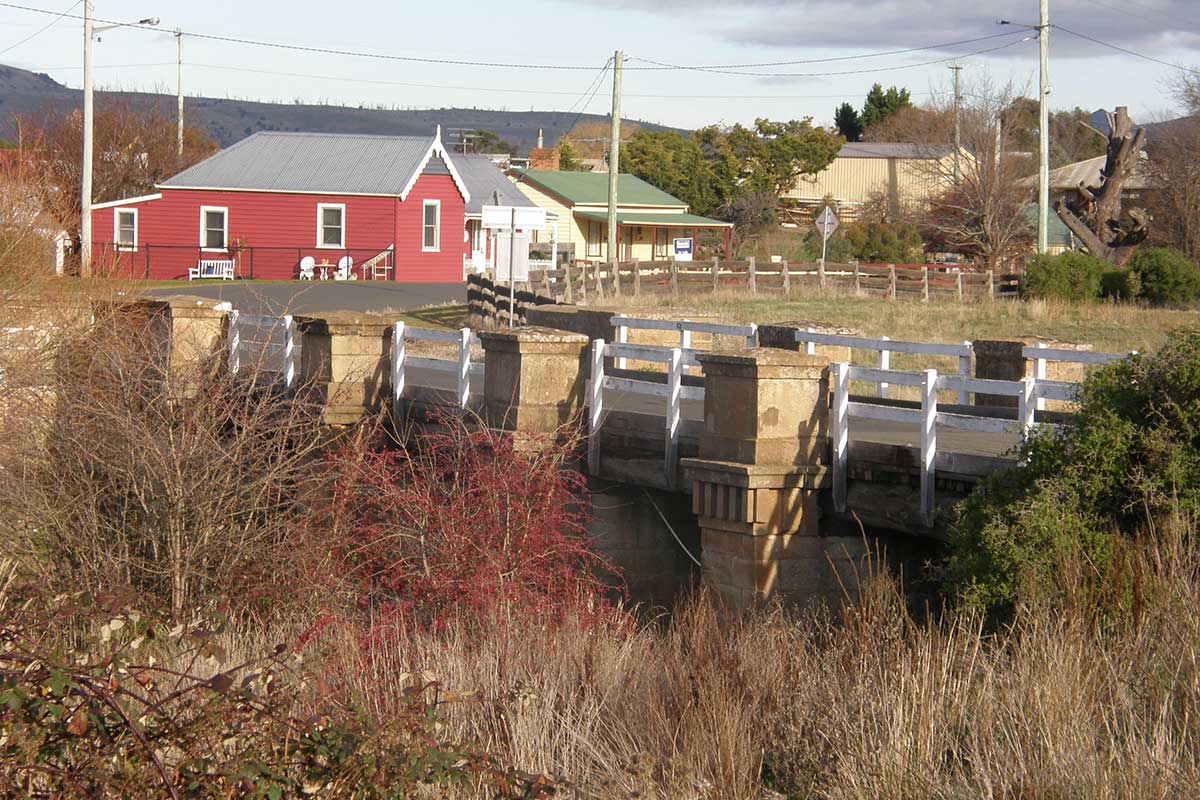
Built in 1848, the Tunbridge Convict Bridge at the northern end of the town was constructed by convicts. It spans the Blackman's River, the traditional boundary between the northern and southern regions of Tasmania. It is particularly important as it is a rare example of a sandstone bridge with timber decking.
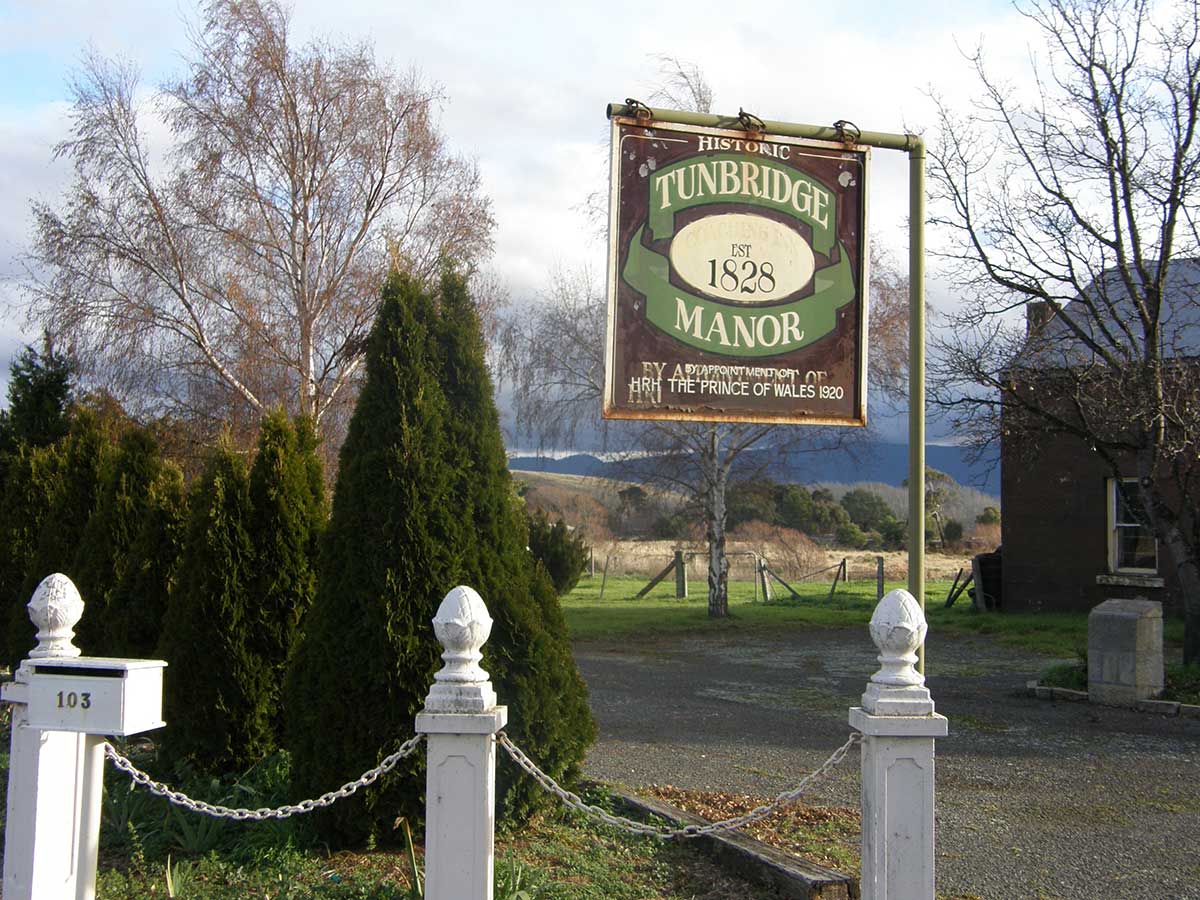
Tunbridge Manor, located in the centre of town, dominates the townscape. Built in the 1840, as a staging post for the early transport days, where the premises offered accommodation, meals, beverages and stabling for horses. Up until the late 1960's when the highway by-passed the town, it was a magnet for the hungry traveller. For the latter years it has been a private residence. Overall the property is still in good condition. Built over 3 stories, the building has up to 8/10 bedrooms, various bathrooms, large living space, attic rooms, and cellars. Outside there are stables, garages, various sheds, all located on 10 acres bordering the Blackman River.
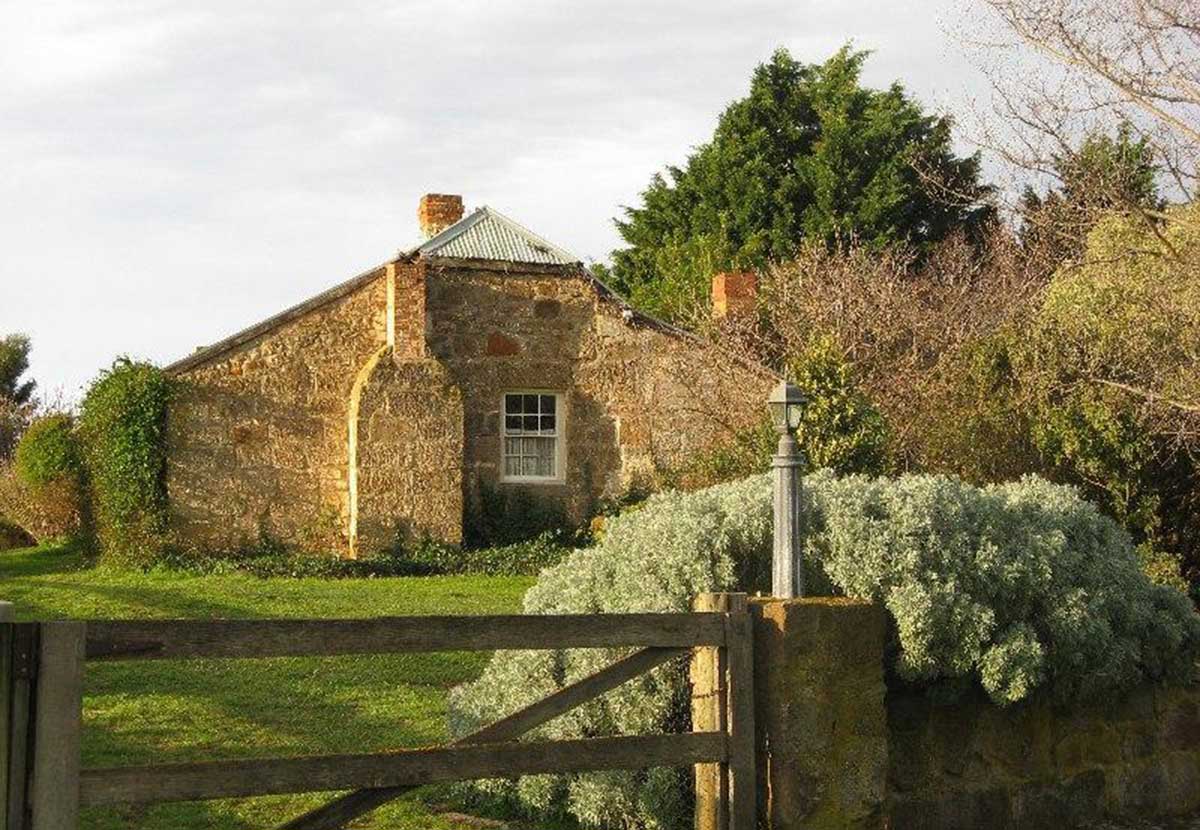
Built in 1825, the Tunbridge Wells Inn is a fine example of a single-storey Old Colonial Georgian inn and farmhouse with its long medium-pitched broken-back roof, half-hipped gables, enclosed eaves, flagged veranda and extensive use of local rough-hewn and rubble stone. The Inn boasts four large bedrooms, two large living areas, two kitchens a dining area, two bathrooms, a large converted loft, sun room and central corridor. The building’s design allows for one large residence or two separate residences both with separate bedrooms, a living area, kitchen and bathroom. The building has five fire places, three in bedrooms, and one in both the main living area and kitchen. There are four doors accessing the house from the front veranda and two from the rear.
The Inn was strategically erected by Thomas and Ann Flemming, along the original Main Road from Launceston to Hobart. Thomas (1801-1870), from Watlington, Oxfordshire, England, was one of 200 convicts transported on the Sir William Bensley, departed England October 5, 1816, arriving in Port Jackson, now Sydney. On March 10, 1817, 15 yea-old Thomas was transferred to the Elizabeth Henrietta arriving in Hobart Tasmania on March 27, 1817. He got his ticket of leave February 1824 and received his free ticket December 18, 1825 upon completion of his 7-year sentence for armed robbery. The establishment operated as an Inn until the 1840’s and as a farmhouse after this time. Within the centre of the building, adjoining the main living room, remains of a temporary holding cell for either prisoner’s en route or valuable goods can be seen. Cobble stone remnants of the former Main Road between Hobart and Launceston can be found along the front of the main building today. Location: 11 Victoria Street, Tunbridge

Bowerman's General Store
Bowerman's General Store, a two storey Georgian building with a five bay facade and slim columns. The building features two timber shopfronts, four mullioned sections with round tops and panelling below each side of double entry door. The single storey timber verandah was added later. This building has been restored and mostly likely a private residence these days.

Victoria Inn
Victoria Inn was built in the 1840s as a large hotel and served as a coaching stop on the main road between Hobart and Launceston, offering accommodation, meals and beverages. In the old coaching days, the horses were changed at the Victoria Inn stables, which remain at the side of the property. Next to the stables is a barn with a huge hay loft. Over the years, the hotel has also been known as Powell’s Hotel and Tunbridge Hotel. It is now a private residence. The building was constructed from locally quarried sandstone and cedar wood and was spaced over 4 levels with 8 guest rooms and three bathrooms. It stands on a 10 acre property which is part of an original grant of 60 acres allocated in 1821 by Gov. Lachlan Macquarie.
Other buildings of importance include the Colonial Homestead was built in 1820, the The Victoria Inn , the Coaching Stables (1843), The Blind Chapel (now the Masonic Hall and reputedly 'blind' - no windows - on one side so the parishioners didn't have to look at the local pub.

Tunbridge historic display
An original stage coach belonging to Samuel Page Coaches, which was used on the Hobart to Launceston run, is featured in the village's historic display. It was styled on the English road coach on which both the driver and guard were dressed in livery. In 1844 the trip took 17 hours, with Tunbridge being one of numerous stopping places where the coach broke their journey with an overnight stop. The fare to travel inside the coach was one pound ten shillings, and to ride on the roof 15 shilings (there were 20 shillings in a pound). A farm labourer's wage at the time (1851) was 38 pounds a year. Bricklayers and masons were paid piecemeal 10 shillings a day.
Samuel Page (1810 – 1878) held the government contracts for the Royal Mail coach deliveries between Hobart and Launceston. In addition to the Royal Mail, Samuel Page transported prisoners from regional stations and courts to be "received" at H.M. Gaol, Hobart, accompanied by constables. At the height of the coaching days, Page had seven coaches and around 150 horses that carried both passengers and the mail; and became a very wealthy man in the process. During his coaching operations Page acquired many pastoral properties, including Thomas Anstey’s property, Anstey Barton. At one time his landholdings and his flocks comprising 63,000 sheep were said to be the largest ever held by one person in the colony. Page was also an enthusiastic breeder of race-horses and helped to found the Tasmanian Racing Club in Hobart.
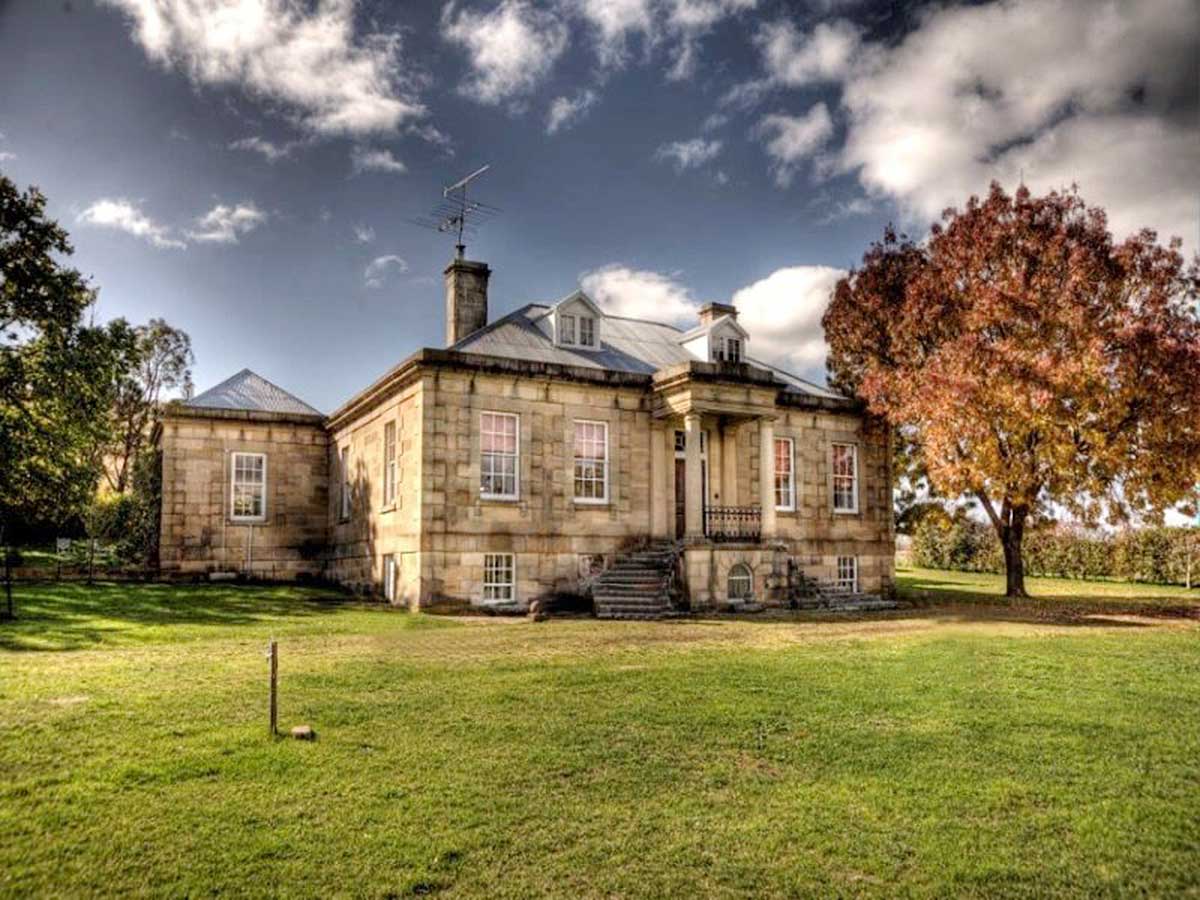
Ballochmyle homestead
One of Tasmania's Finest Sandstone Georgian Homes, Ballochmyle homestead, stables and cottage were built in the 1830s for James Maclanachan. This historically significant home features many of the finest aspects of an exceptional Georgian residence of this era. Superior sandstone construction, beautifully crafted Cedar joinery throughout and a magnificent Tuscan portico flanked on each side with gracefully curved sandstone steps. There are numerous outbuildings, including a significant original checkerboard convict built brick barn complex (estimate at over 250,000 convict bricks), a delightful two story sandstone manager's cottage, original shearer's quarters and other outbuildings. The Estate is situated on approx. 125 acres near the Blackman River, with its own private lake. Location: 160 Ballochmyle Road, 2km north-east of Tunbridge.
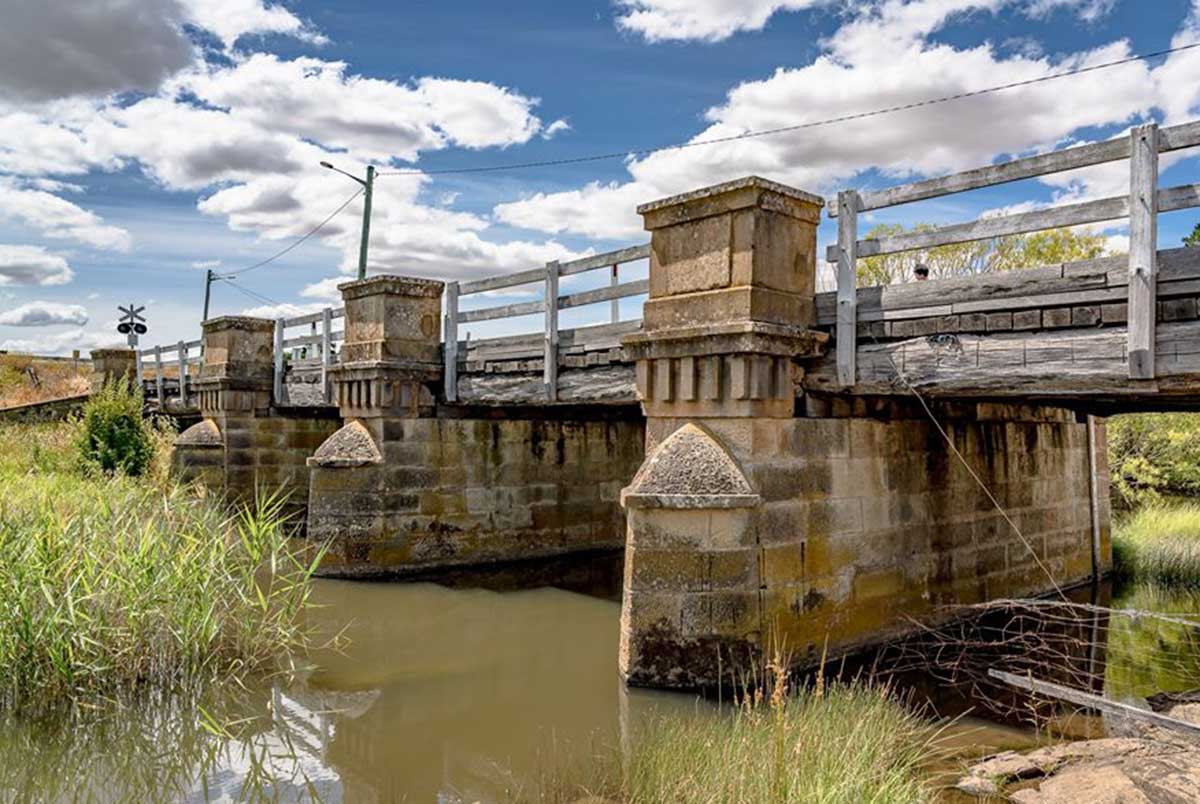
Tunbridge and The Young Irelanders
Tunbridge Convict Bridge was used as a secret meeting place for a fascinating group of political exiles known as the 'Young Irelanders'. To avoid being seen, they arranged with the local inn to deliver food where they gathered under the bridge. The Young Irelanders roamed far and wide across Tasmania, where Irish sympathisers gave them food and shelter as well as hiding them from the authorities.
Thomas Francis Meagher (1823-1867), an Irish nationalist, led the Young Irelanders in the Rebellion of 1848. After being convicted of sedition, Meagher and his colleagues were first sentenced to death, but received transportation for life to Van Diemen's Land (now Tasmania). In July 1849, Meagher was transported from Dun Laoghaire on the S.S. Swift to join his friend and co-rebel, John Mitchell, in Tasmania. He would never see Ireland again.
Meagher accepted a "ticket-of-leave" upon giving his word not to attempt to escape without first notifying the authorities, in return for comparative liberty on the island. A further stipulation was that each of the Irish "gentleman" convicts was sent to reside in separate districts: Meagher to Campbell Town and shortly after to Ross (where his cottages still stand); Terence MacManus to Launceston and later near New Norfolk; Kevin O'Doherty to Oatlands; John Mitchell and John Martin to Bothwell; and William Smith O'Brien (who initially refused a ticket-of-leave) to the Darlington Penal Station on Maria Island and later to New Norfolk. During his time in Van Diemen's Land, Meagher managed to meet clandestinely with his fellow Irish rebels under the Tunbridge Convict Bridge.
On 22 February 1851, in Van Diemen's Land, Meagher married Catherine Bennett, daughter of Bryan Bennett, a farmer who, in 1817, had been convicted of mail robbery and in 1818 transported to Van Diemen's Land. Meagher's fellow exiles disapproved of his marriage because she was a "dead-common girl", or the child of a common criminal. Although his friends believed her social status made them an unsuitable match, Meagher was unperturbed, and his wife and he lived in a house Meagher built on the shore of Lake Sorell. Soon after they were married, Catherine became ill.
Less than a year after his wedding in January 1852, Meagher abruptly surrendered his "ticket-of-leave" and planned his escape to the United States. Meagher sent his "ticket-of-leave" and a letter to the authorities, along with notifying them he would consider himself a free man in twenty-four hours. In November 1852 Meagher’s now in-laws procured a boat for him and under cover of darkness, he escaped to New Zealand, and from there made his way to New York City. When he escaped, Catherine was in an advanced stage of pregnancy and stayed behind. Following Meagher's departure from Van Diemen's Land, their son, Henry Emmett Fitzgerald O'Meagher was born, but he died at 4 months of age, shortly after Meagher reached New York City, age 29.
The infant son, Henry Emmett Fitzgerald O'Meagher was buried on 8 June 1852 at St. John's Catholic Church in Richmond, Tasmania. The small grave is next to the church. A plaque notes his father having been an Irish Patriot and member of the Young Irelanders. Following Meagher's escape and the death of her son, Catherine travelled to London. She died in Ireland on 12 May 1854, at the home of Meagher's father.
Meagher was given a hero's welcome when he arrived in New York after 2 years in exile. Here he studied law, worked as a journalist, and travelled to present lectures on the Irish cause. Meagher re-married in New York City, where he studied law and journalism.
History records Meagher’s exploits and major contribution to the Union side during the American Civil War. Meagher would go on to raised the Irish Brigade and command it from February 3, 1862 to May 14, 1863. After the Civil War Meagher became Secretary and Acting Governor of the Montana Territory. He drowned in the Missouri River near Fort Benton in July 1867. Many believed his death to be suspicious and in 1913 a man on his deathbed, claimed to have carried out the murder of Meagher for the price of $8000, on recovering, however he then recanted his confession.
In The Area
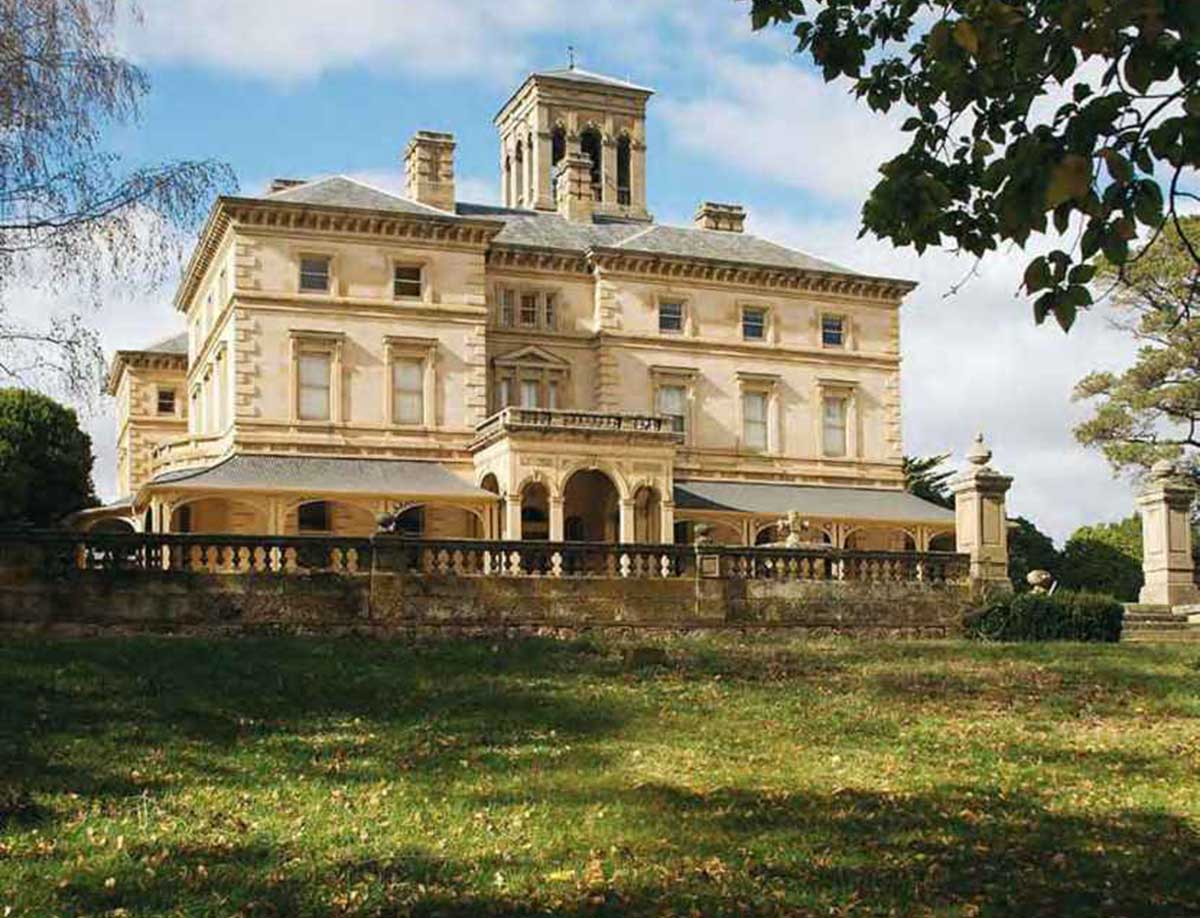
Mona Vale homestead and outbuildings
This grand three storey stone villa has often been referred to as the Calendar House due to its 365 windows, 7 entrances, 52 rooms, 12 chimneys. It has a single storey verandah to north and east sides with concave rolled roof and twin columns. The entrance portico has a balustraded terrace over very fine stone and stonework, strings, quoins, a bracketed cornce over level two windows and bracketed eave. A splendid glasshouse is adjacent to house, along with fine stone outbuidings, cottages and a chapel set in extensive gardens.
Mona Vale was designed by William Archer (architect and owner of Cheshunt) for his brother-in-law, Robert Quayle Kermode, and was completed in 1868, just in time to host a visit by Queen Victoria's son, the Duke of Edinburgh, on the very first royal visit to Australia. This was a significant moment for Mona Vale, and indeed for Tasmania, as it was hoped that the royal visit would lend a mark of respectability to the island and assist in burying its maligned convict past.
So in addition to ensuring the palatial homestead, extensive gardens, conservatories and exquisite chapel were fit for a queen's son, Mr Kermode went to the trouble of commissioning a royal bed, a four-poster with the arms of Edinburgh adorning its cedar footboard. People still sleep in this bed in the Duke of Edinburgh's room, one of ten bedrooms on Mona Vale's second floor. The Duke planted an oak tree in the gardens while he was a guest at Mona Vale, and it continues to thrive.
The impressive visitors' book continued well into the next century. In the 1920s, owners Eustace and Alexina Cameron entertained the future King George VI and Queen Elizabeth at Mona Vale. Even earlier than that in 1912, the legendary Lord Kitchener paid a visit to inspect the empire's troops, as the light horse regiment was based at Mona Vale for many years (the Cameron family have a long military history). Location: Mona Vale Road, off Midland highway, 7km south of Ross.
More
Antill Ponds
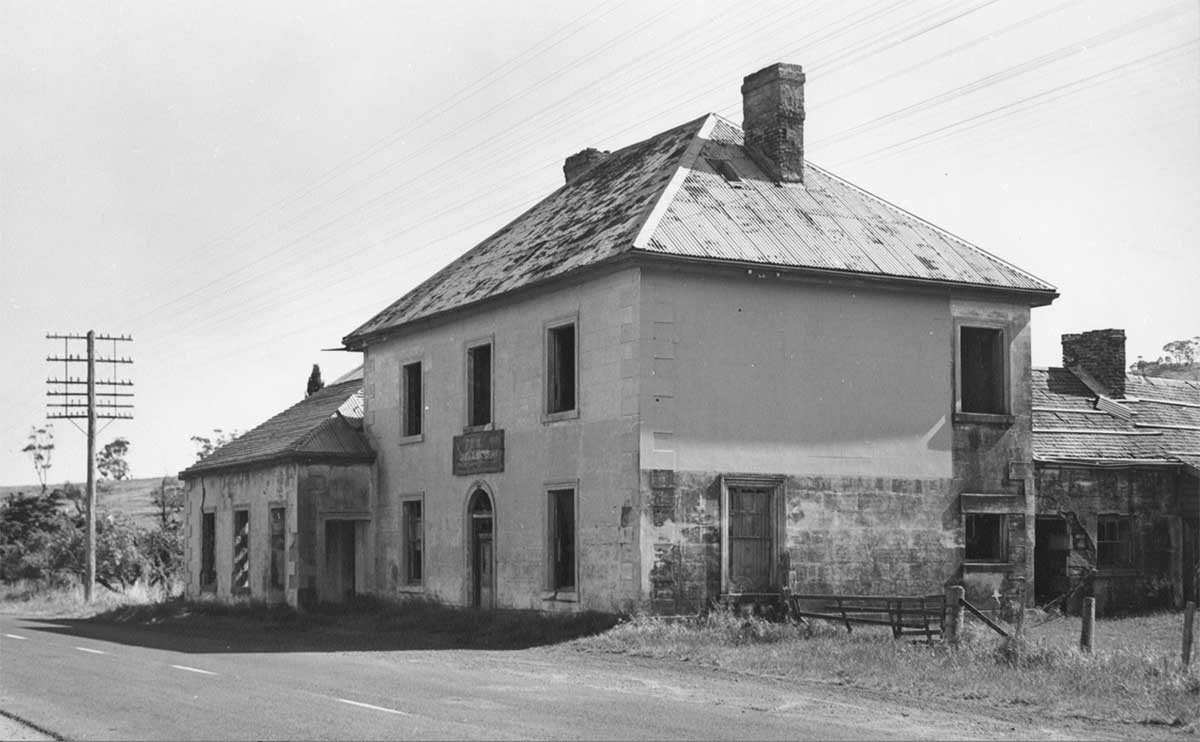
Half Way House, Antill Ponds
Antill Ponds was a small township about half way between Launceston and Hobart on the main highway, 13 km to the south of Tunbridge. Today there is nothing left but ruins and a railway line. Antill Ponds was a well-known resting place for travellers in the days of coaches; it takes its name from the ponds of fresh water at the entrance to the Salt Pan Plains so named by Gov. Lachlan Macquarie. The locality is about 12 km north of the town of Oatlands. The North-South Railway Line and the Midland Highway pass through the locality.
Antill Ponds was named at the end of 1811 after soldier and settler Major Henry Colden Antill (1779-1852). Henry Colden spent his youth in Canada, returning to Britain in when 1796 he joined the British army as an ensign in the 73rd Regiment. He served in India and at Seringapatam was severely wounded in the shoulder. In 1799 he was promoted lieutenant and about this time became associated with Captain Lachlan Macquarie, with whom he formed a firm friendship. In 1809 he sailed to Australia with his 73rd Regiment, now commanded by Macquarie. On arrival in Sydney on 1 January 1810, Antill was appointed aide-de-camp to the governor, and in 1811 promoted major of brigade. He accompanied the governor on his tours throughout the settled areas and on a visit to Van Diemen's Land in 1811.
More about Major Henry Colden Antill

Half Way House ruins
A prominent feature and the social centre of Antill Ponds was The Half Way House, a three storey hotel which serviced both travellers and locals with accommodation, meals and liquor. Adjacent stables were also a changing station where hard-driven coach horses were changed for fresh animals. Only the highway separated the railway station and platform from the front door of the hotel, a distance of about 20 metres. The Half Way House was built by Dennis Bacon, who came to Tasmania, in 1833, from Dublin in Ireland, under an immigration scheme, along with his brother John. Dennis and John were stonemason's and they constructed some beautiful buildings. Dennis centered his business activities around the town of Ross. He held the licence of the Ross Hotel, and later moved to the Half-Way House at Antill Ponds.
Rockwood Stables ruins
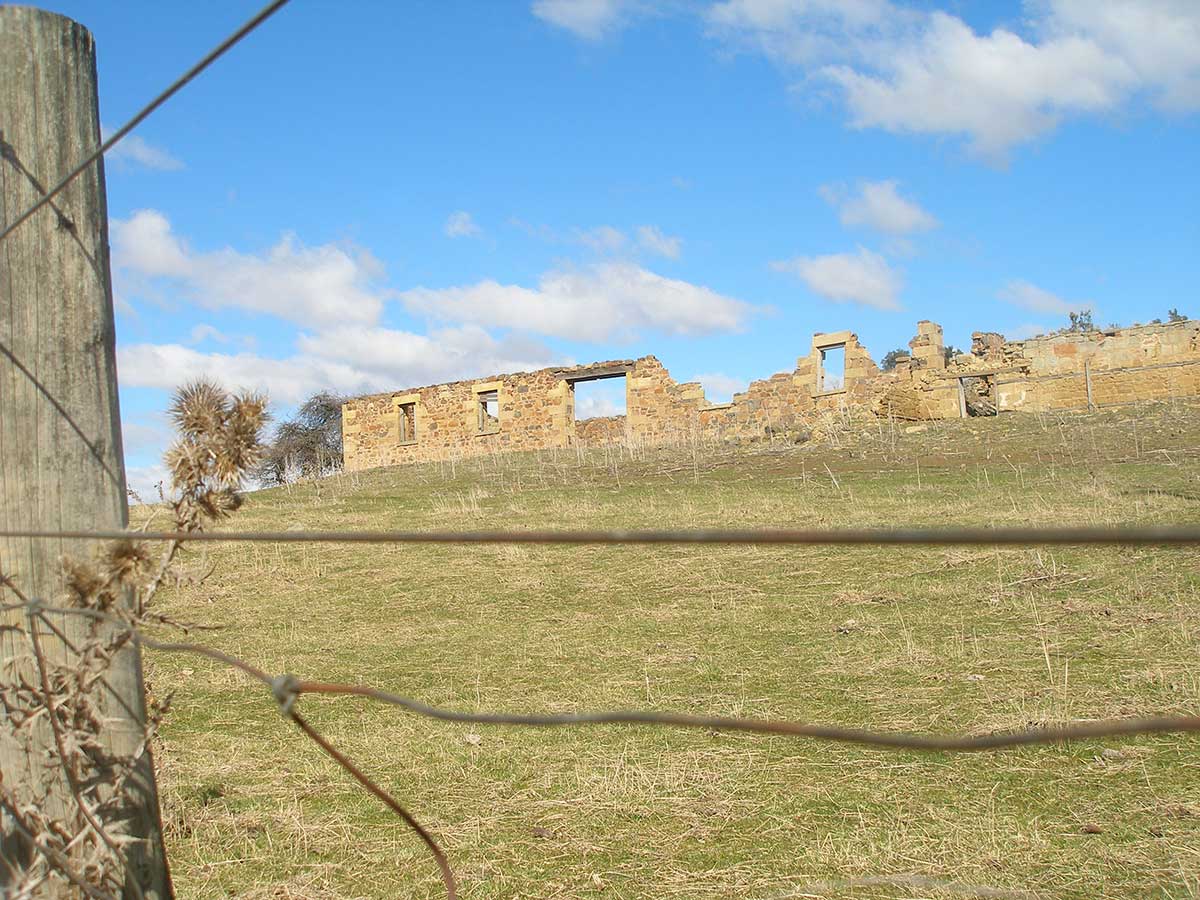
The ruins that can be seen on the western side of the Midlands Highway at Antill Ponds are those of Rockwood Stables, which were part of a large complex of buildings built by Thomas Harrison, the son of Robert Harrison of Woodbury House. According to a sale notice of 1890: "The Thompson property had 160 acres are under cultivation, and the remaining 1760 acres was good sound grazing land. On the cultivated land crops of 62 bushels of wheat to the acre have been grown. There is a large well-built stone house of 12 rooms, surrounded by a productive garden and orchards. Also a stone cottage of six rooms, with 4-stall stable, granary, and 8 shearing-shed, all built of stone." The homestead was destroyed by fire prior to 1920.
Woodbury

Shepherd's cottages on the Woodbury property
Woodbury is a rural locality located about 15 kilometres north of the town of Oatlands midway between Antill Ponds abd Tunbridge. According to the 2016 census, Woodbury has a population of 27. Many of the boundaries of the locality consist of survey lines. The North-South Railway Line passes through the centre of the locality. National Route 1 (Midland Highway) passes through from south to north.
Woodbury takes its name from a local farming property named by the original grantee, Robert Harrison, who arrived in Van Diemen's Land with his wife Elizabeth and five children from Essex, England, on 26th September 1823, per 'Mariner'. Harrison arrived with 17 Saxon Merino sheep, the only survivors of the 34 that left England with him. His flock comprised 100 pure merinos and 2,600 crossbred sheep in 1828 when he applied for and was granted an additional 1,000 acres adjoining Woodbury by Lieut-Gov. Arthur. Harrison was looked upon as a patriarch of the Midlands and its merino breeding industry. The graves of Robert and Elizabeth Harrison are in the St Peter's churchyard, Oatlands.
Glen Morey salt pans
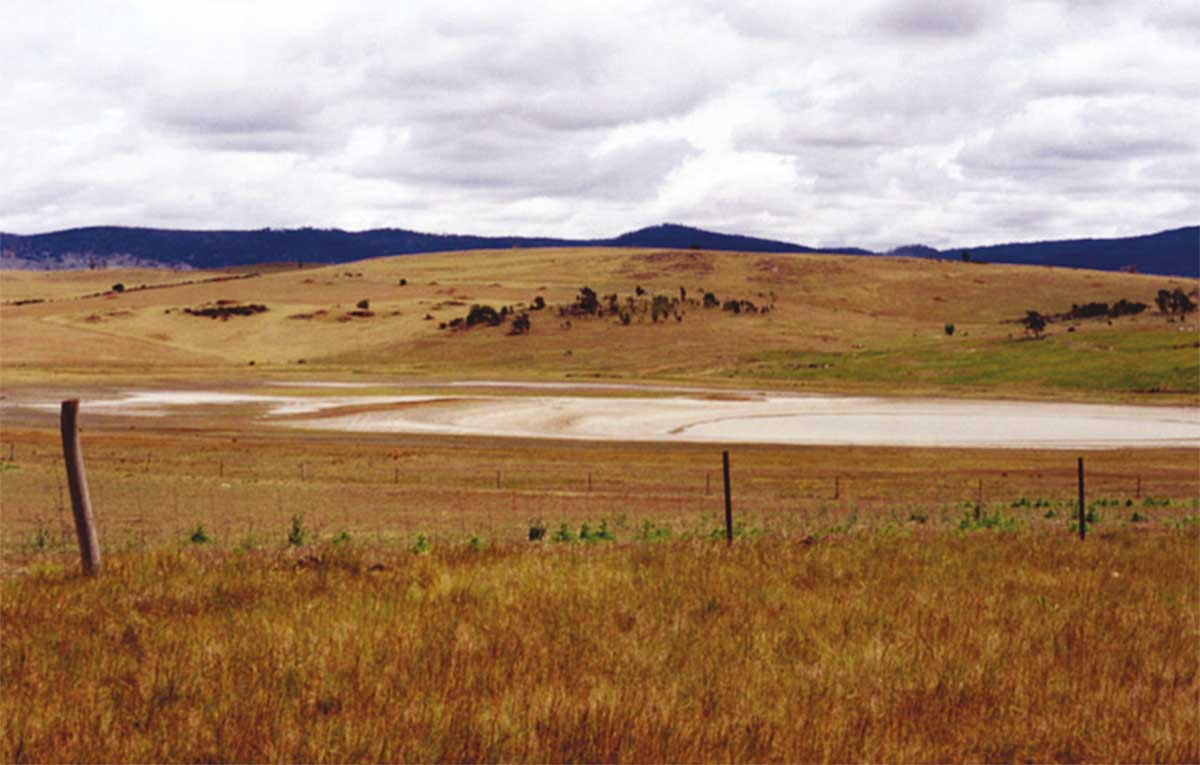
To the north of Woodbury lies an area known as Salt Pan plains. On these plains ia property named Glen Morey, taken from a salt pan on the property that had been found and named by Gov. Lachlan Macquarie in 1811. The property was part of acreage first granted to Robert Davidson, from Nairn, Scotland, who is recorded as residing there in 1835. The Salt Pan Lagoon on the property was fed by a spring. Beneath the surface of the laggon was a massive salt deposit, that as early as December 1818, had been examined by a government geologist who found its salt to be 99% pure when analysed. Up until that time, salt had to be imported from Europe at great expense, but now, with a seemingly unlimited supply created with the evaporation of the water in the salt pan in summer, the colonies didn't to import salt any more.
In 1854, 250 tons of salt was taken from the Glen Morey lagoon for domestic use as well as tanning. A century later, the total output had exceeded 1,000 tons; in the summer of 1973, the annual yield was 600 tons. Salt has been harvested manually up until the turn of the 21st century. In recent years, the Salt Pan Plains have been developed into magnificent open grazing country which also produces high yields of when sown with wheat.